By Daniel R. · Updated 2026-08-17 · 13 min read
The stream died at the exact moment it mattered most — 88th minute, your team pushing forward, the ball in the box. Then the little buffering wheel appeared, spinning like it had all night. You unplugged the power, plugged it back in, and met the same spinner. A minute later the TV went black. "No signal." Again. All while the EPG grid in the photo above sat there looking perfectly normal, showing the match you were supposed to be watching.
The worst part is that everything seems fine in the morning. You test, it works, you think it fixed itself. Then the next evening, the same failure at kickoff time. This pattern is so common that almost every IPTV troubleshooting thread on the internet is about it — and most of the advice in those threads will not solve anything.
In nearly every IPTV box problem I have analyzed, the box itself was not the main fault. The real causes sit in a small set of network and app settings that people get wrong without noticing. This guide walks through the three most common mistakes, why rebooting does nothing, the step-by-step fixes that actually hold, and what results a properly configured 4K IPTV box can deliver on a normal home internet connection.
The 3 most common mistakes with iptv box
Mistake 1: Buying the box before checking the service
Most people pick a box first, then look for a subscription. That order creates compatibility surprises. The box you bought may not have the Wi-Fi antenna range your router needs, or the operating system version your provider’s app requires. A cheap iptv box with wifi can stare at you from the shelf with a tempting price, then fail the moment you load a heavy live sports stream. The hardware and the service must be chosen together — not separately.
If you already own the box, the next 20 minutes will tell you whether it is worth keeping. Test it with a free trial or a one-dollar trial subscription before buying any plan.
Mistake 2: Trusting the pre-installed IPTV app
Retailers preload IPTV boxes with a custom launcher and a bundled player. It looks polished, but that bundled player is often years old, uses software decoding, and offers no buffer options. The pre-installed app is a marketing tool, not a performance tool. Experienced users replace it with a dedicated player like TiviMate on the first day — and most "the box is slow" complaints disappear overnight.
Mistake 3: Diagnosing alone at one time of day
One speed test at 10 a.m. says nothing about 8 p.m. on game night. Peak-hour congestion, ISP throttling of IPTV traffic, and Wi-Fi interference all appear only at certain hours. If you judge the whole setup by one morning test, you will keep rebooting a system that fails only when it matters most.
Why the usual solutions fail
Every forum reply says the same three things: restart the router, unplug the box for 30 seconds, and factory reset if that does not work. Those are fine for a genuinely hung device. But they only reboot the same configuration that just failed. If the app’s decoder is incompatible with the stream’s codec, a reset will not change the codec. If your ISP has started shaping IPTV traffic at peak hours, a reset only reconnects you to the same shaped path.
The "buy more internet speed" advice is also wrong for most cases. IPTV is a low-latency pipeline. Download speed matters far less than jitter, packet loss, and the route your ISP takes to the provider’s servers. A gigabit line can buffer a 5 Mbps live stream when the route quality collapses at 9 p.m.
What experienced users do differently
People who have run IPTV boxes for years develop a few habits that newcomers skip. Here are the ones that change almost everything:
Test the service on a second device first. If the same channel runs smooth on your phone but stutters on the box, the problem is not your subscription — it is the box or the app. This single test saves hours of wasted resets.
Wire the box to the router for the first 24 hours. Ethernet is the fastest way to find out whether your Wi-Fi antenna is the weak link. If the buffering disappears on cable, you now know exactly where the problem lives.
Replace the bundled player with TiviMate or another real player. These offer buffer size control, hardware decoding, and modern EPG support. The bundled app rarely does.
Match resolution to the TV screen. If your screen is 1080p, let the box output 1080p. Forcing 4K output into a 1080p panel causes HDMI renegotiation, black screens, and "no signal" drops.
Choose an iptv box subscription no contract for the first month. A monthly plan that you can cancel gives you a clean test window and a clean exit. Year-long deals are how sellers hide a bad service.
Use a VPN only when your ISP is visibly throttling IPTV. The box itself does not need a VPN. Some ISPs slow down live-streaming traffic on weekend evenings; a VPN can hide the traffic type. Test without it first, and add it only if the symptoms point that way.
✓ Benefits & Pros
Live sports without a cable contract, streamed on your existing internet plan. That is why many households pick a dedicated box as their best iptv box for live sports option.
One box per TV is cheap enough, and many providers allow multi-screen accounts, so an iptv box for multiple TVs can cover the whole house without a second cable bill.
The box itself costs $40–$80, so the main financial commitment is the subscription, not the hardware.
✗ Limitations & Cons
Reliability depends on your internet route and the provider’s server load. You cannot fix a dead server from your sofa.
Quality varies massively between models — a 4k iptv box review might praise a unit that silently throttles after 20 minutes.
Technical setup is required: network bands, decoders, VPNs, and player settings are real requirements, not optional extras.
RECOMMENDED RESOURCE
iptv box
Read independent network latency reviews and hardware specs before you spend money on a subscription.
Find Out More About iptv box →
Step by step: how to fix your iptv box in this order
The photo above shows exactly what a healthy stream should look like: crisp football action, no blocking, no frozen frames. Getting there requires working through the steps in sequence. Jumping straight from symptom to the most complicated setting is how people break a setup that was already 80% fine.
1. Run the box on an Ethernet cable for 24 hours
Disconnect Wi-Fi completely. Plug the box into the router with a cable. If the buffering disappears, your Wi-Fi antenna, band, or router placement was the problem. No app setting will fix a weak wireless path.
2. Test the same channel on another device
Open the same stream in VLC on a PC, or in a second IPTV app on your phone. If the other device handles it cleanly, the box’s app is the weak link. If both devices struggle, the problem is upstream — provider, internet route, or ISP throttling.
3. Update the Android system and the IPTV app
Go through the box settings: About device → System updates. Then open the app store and update the IPTV app to the current version. Old apps and old Android builds are the second-biggest source of "no signal" failures.
4. Clear the IPTV app’s cache, not the whole box
Settings → Apps → select your IPTV app → Clear cache. Cache buildup from automatic EPG updates eventually starves the app of storage and RAM. This fixes most random freezes without losing your channel list or login.
5. Switch between hardware and software decoding
In most IPTV players, this setting sits under Decoder or Playback. If the image is jittery or shows green blocks with hardware decoding, switch to software. If it gets worse, switch back — you have now learned the actual codec limits of your box.
6. Set output resolution to the TV’s native resolution
Open the box’s display settings. If your TV is a 1080p screen, set the box to 1080p output, not 4K. Forcing 4K output into a 1080p panel causes HDMI handshake drops and black-screen moments on channel changes.
7. Change the DNS server
In the network settings, use a static IP and set DNS to Cloudflare 1.1.1.1 or Google 8.8.8.8. This solves ISP-level DNS issues that make channel lists load slowly or the EPG take minutes to fill.
8. Separate your Wi-Fi bands
If your router broadcasts 2.4GHz and 5GHz under one SSID, split them and connect the box to 5GHz. It has a shorter range but far less interference from microwaves, cameras, and neighboring networks.
9. Reduce demand on the box
Close background apps, disable automatic EPG updates, and if the provider offers multiple bitrate versions of a channel, choose a 1080p version instead of 4K when the network is congested. Peak hours are not the time to push the box to its max.
Realistic results after applying the fixes
With Ethernet, TiviMate, and the correct display resolution, channel switching usually drops to 2 or 3 seconds, and the mid-match spinner basically disappears. This is a measurable, repeatable change — not a placebo.
Expect some channels to fail regardless of your setup. Every provider has a few dead streams on any given night. It is the nature of the service, not your box.
About true 4K live sports: a 4k iptv box review that promises every match in real 4K is overselling. True 4K sport requires a provider that actually encodes in 4K, a sustained 25–50 Mbps connection, and a screen large enough to notice the difference. On a 55-inch 1080p TV, most people are watching 1080p anyway.
Pitfalls to avoid after you get things working
Avoid “lifetime” IPTV subscriptions. These deals disappear when the provider disappears — usually within months. A no-contract monthly plan keeps your money safe and gives you a clean exit at any moment.
Do not let the box overheat. Setting it inside a TV cabinet, on top of a router, or behind an amplifier is common. Excessive heat causes freezes, reboots, and HDMI handshake failures.
Do not install ten IPTV apps on a low-RAM box. If the box has less than 2GB of RAM, one app in the foreground is all it should handle. Stacking apps is how people get a box that needs a reboot every night.
Do not trust a convincing “4K” label on a no-name device. When you check where to buy iptv box options, look for a listing that clearly states the processor, RAM, Android version, and Wi-Fi bands. A cheap iptv box with wifi can be a steal or e-waste — the spec sheet tells you which one you are paying for.
What works vs. what doesn’t: the honest comparison
Here is the table I wish existed before buying my first box. It compares the typical troubleshooting step with the fix that actually holds.
IPTV box vs Firestick: which should you use?
When people ask how to set up an iptv box, they usually mean: should I get a dedicated box or just use a Firestick? The answer depends on the app and the hardware in the room.
Access zero-contract options and instant delivery specs.
See iptv box Pricing →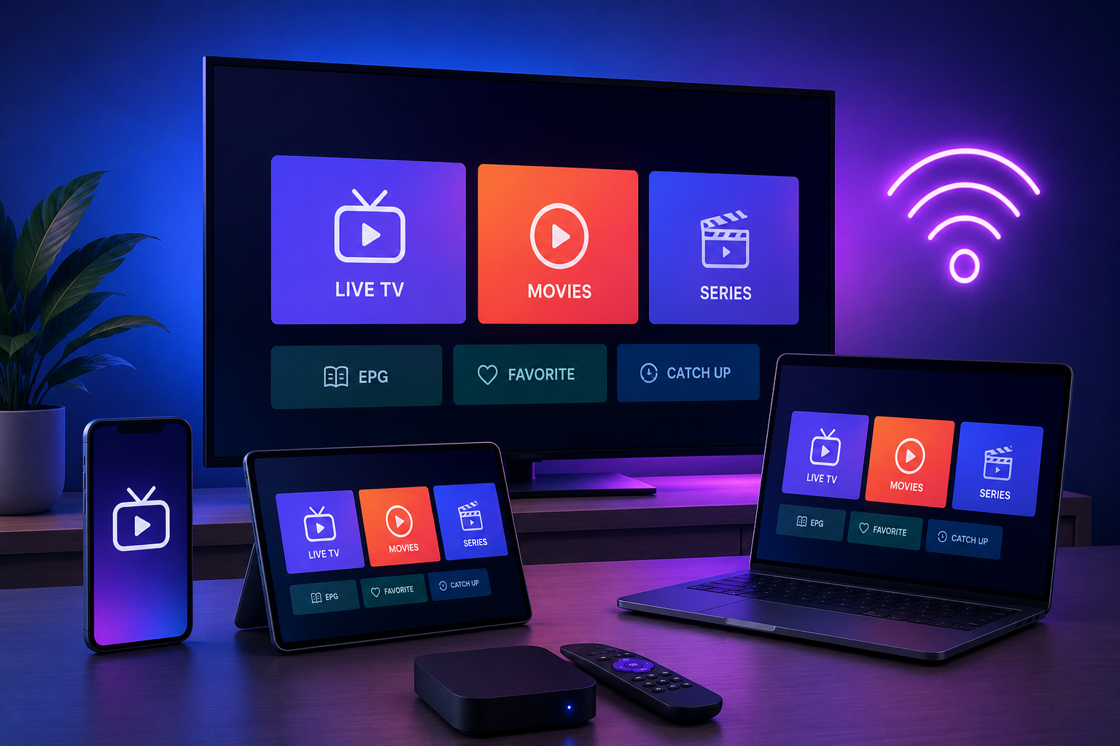
Bottom line: your IPTV box is probably not broken
The image above shows the modern IPTV setup — a TV app, a remote, a router somewhere nearby, and the streaming source behind it all. That entire stack is what most people call “the IPTV box.” Fix the stack, and the box follows.
Start with Ethernet, test the same stream on a second device, replace the bundled player with something like TiviMate, and keep your first subscription on a month-to-month contract. Those four habits solve the vast majority of problems I see people blame on hardware.
Doing this puts you in the category of people who get years of stable service from their IPTV box, rather than the category that keeps buying new boxes and blaming the wrong layer.
Featured Streaming Selection:
View the iptv box Platform →Affiliate Disclosure: Clicking this secure link verified by our network supports our team through standard partnership terms at zero extra cost to your invoice.
Frequently Asked Questions
This article contains affiliate links. Our editorial analysis remains independent.