By Daniel M. · Updated 2026-08-16 · 13 min read
Your subscription page says best iptv service. The order receipt says premium. But tonight it behaves like anything but: the match freezes at minute 23, the channel list takes forever to load, and when you switch to a news station you get a black screen for ten seconds. The image above shows the warning signs — the app loads, the connection indicator looks healthy, and the stream still stops.
The frustrating part is that your internet speed checks out. YouTube plays 4K without a hiccup. Netflix works fine. So why does IPTV buffer, freeze, and fail exactly when you need it most?
The answer: most IPTV failures have nothing to do with your broadband and everything to do with three specific mistakes that nearly every new user makes. And the usual advice — restart your router, try a free VPN, upgrade your internet plan — never addresses the root cause. In this guide, I'll walk through the real problem, show you what experienced users do differently, and give you a step-by-step fix that works on Firestick, Android TV, smart TVs, and mobile.
The 3 Most Common Mistakes With the Best IPTV Service
Mistake #1: Choosing a Provider by Channel Count Alone
Provider pages love to show 50,000+ channels and 10,000 movies. That number is almost meaningless. A service can advertise a massive catalog while routing everyone through one overloaded server in a single data center. When you watch a live match on a Saturday evening, that's exactly when everyone else watches too — and the server buckles. Channel count says nothing about server capacity, and server capacity is what separates a working subscription from a broken one.
Mistake #2: Using the Provider's Default App and Player
Many IPTV services push their own app on you. These apps are often generic white-label players that use a software video decoder with no hardware acceleration. On a Firestick — especially an older 2nd or 3rd generation model — 1080p and 4K streams stutter because the player is too heavy for the device, not because the stream is bad. Reinstalling that same app over and over produces exactly the same result.
Mistake #3: Skipping the Device Compatibility Check
When people search for the best iptv service for firestick, they assume every Firestick is identical. The Fire TV Stick 4K Max handles almost anything; the older standard Fire TV Stick does not. The same applies to older Samsung or LG television models. The app installs, so you assume it works. Then when it stutters, you blame the provider, when the real bottleneck is dated hardware running a heavy interface alongside the stream.
Why the Usual Solutions Fail
Let's quickly dismiss the generic advice that appears on every IPTV forum:
"Restart your router." This only helps if the router genuinely crashed. IPTV buffering at 9 PM on a Saturday is almost always provider-side overload, not a router issue. Rebooting changes nothing.
"Try a free VPN." Free VPNs add massive latency and often make streaming worse. Many are already congested, and some even throttle video traffic themselves.
"Upgrade your internet plan." More bandwidth does not help a saturated server. A 500 Mbps plan means nothing if the provider cannot push a stable 4 Mbps stream to your device.
"Reinstall the app." Reinstalling the same player with the same codec settings produces the same result. It feels productive but solves nothing.
In short, these solutions treat symptoms on your side of the network and ignore the actual bottleneck. The bottleneck is usually the provider's server, your device's playback capability, or the software player.
What Experienced Users Do Differently
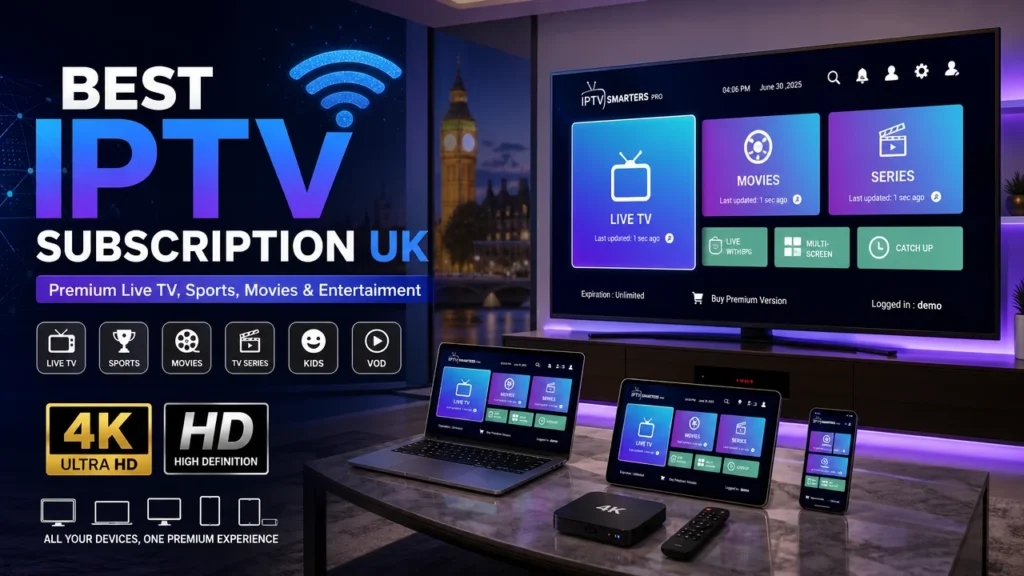
The image above shows what a well-maintained IPTV dashboard looks like: sports, live TV, movies, and series are separated into logical categories, and each category loads its own extended EPG instead of relying on one catch-all m3u file. Experienced users care about this because organization is a sign that the provider actively maintains the service rather than dumping a random playlist onto a server.
Beyond that, experienced users follow a different playbook entirely:
1. They use a dedicated player. TiviMate, Ibo Player Pro, and iMPlayer are the usual choices. These players support hardware acceleration, adjustable buffer sizes, and external video players. The difference is often dramatic.
2. They ask for Xtream codes. Instead of being locked into one app, they ask the provider for Xtream codes or an m3u URL, which works with any modern player. This one request gives them full control.
3. They test on the actual device. Speed tests happen on the same Firestick or smart TV, not on a phone. And they test during peak hours — evening weekends, match days — because that's when servers show their true condition.
4. They avoid VPNs by default. A paid VPN is used only after confirming ISP throttling. A good rule: stream a channel without VPN, then with VPN. If only the VPN version runs smoothly, your ISP is throttling IPTV traffic.
5. They start small. A one-month plan or a trial during a live event tells you more than any review. Reviews describe last year's server quality; a live test reveals today's.
Step-by-Step: How to Fix Your Best IPTV Service Setup
Follow these steps in order. Each one eliminates a possible cause and tells you where the problem lives.
Step 1: Determine which side is failing. Install a free trial from a different provider (or use the trial of your current one if you have not started it). If the trial streams fine, the problem is your provider. If it also buffers, the problem is your network, player, or device.
Step 2: Test the exact device you use. Not your phone — the Firestick, TV, or Android box. Run a speed test app on that device. For smooth 1080p you need a stable 10 Mbps; for 4K you need a stable 25 Mbps with low jitter. Also check the Wi-Fi signal strength displayed in the device's network settings.
Step 3: Bring the device closer or use Ethernet. If the device sits far from the router, that alone destroys IPTV stability. For a Firestick, a USB-Ethernet adapter solves many problems. Try this before you change anything else — it costs less than a new subscription.
Step 4: Switch to a dedicated player. Install TiviMate or Ibo Player Pro, enter your Xtream codes, set buffer size to Large or Extreme, enable hardware acceleration, and test again. You will be surprised how often this fixes stuttering without any other changes.
Step 5: Check for ISP throttling. Turn on a paid VPN and play the same channel. If the stream runs fine only with the VPN, your ISP throttles IPTV traffic. Set the VPN up on your router so every device benefits, but switch it off once your ISP adjusts or you change providers, because VPNs add latency.
Step 6: Match the resolution to your device. If you have an older Firestick or smart TV, set the player output to 720p or 1080p. 4K on unsupported hardware is not worth the stutter. On newer hardware, make sure the device itself is set to the correct refresh rate (60 Hz or 50 Hz depending on your region) to avoid judder.
Step 7: If the problem persists, the provider is the problem. Unsubscribe at the end of your period and apply these lessons to your search. You should now know exactly which questions to ask before paying.
QUICK RESOURCE
Need a Shortcut? Review the Best IPTV Service Setup
See how a well-configured premium subscription looks on Firestick and Android TV, including Play Store app recommendations and trial policies.
Compare best iptv service Plans →Realistic Results to Expect
Be honest with yourself about what a premium IPTV provider can and cannot deliver. After applying the steps above, a reliable service should give you:
Channel zap times between 2 and 6 seconds on a good connection. Zero to one brief buffering event per hour on live sports. Stable EPG data for major channels, with occasional gaps on obscure international channels — that part is normal.
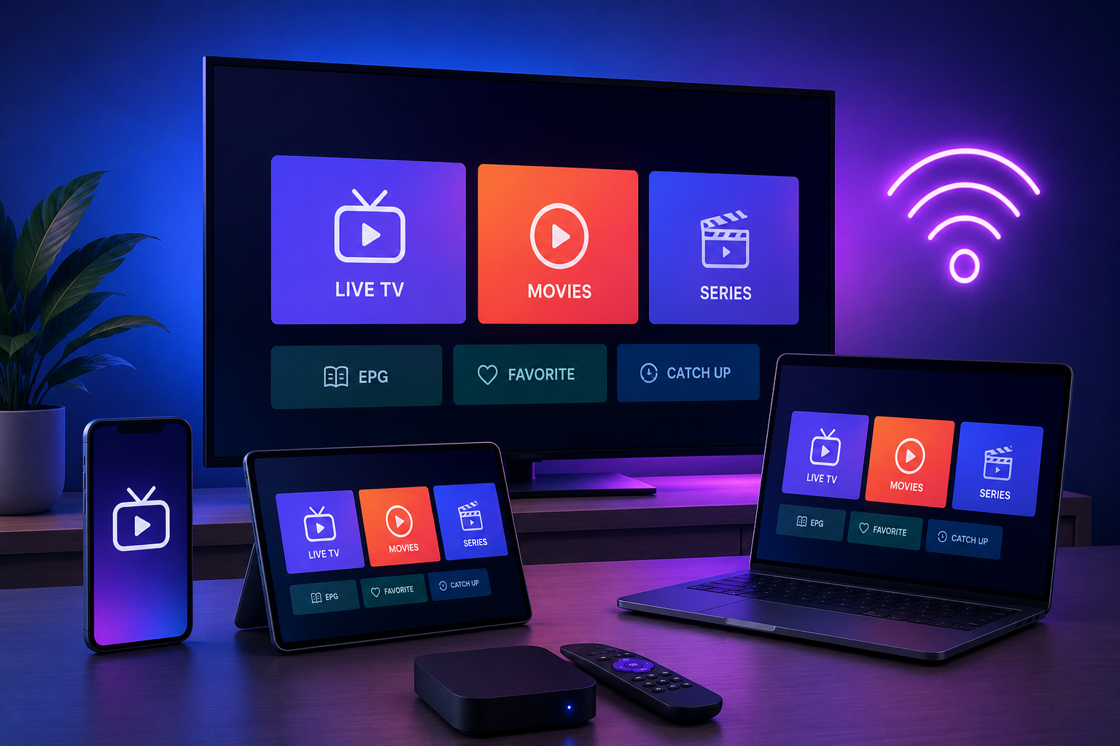
Sports streamed at 4K require more internet stability than 4K movies, because live encoding cannot be buffered the same way. The image above shows the real-world variable: the same subscription performs differently across devices. If you expect Netflix-quality on every IPTV channel, you will be disappointed — you are watching broadcast streams re-encoded for the internet. But with the right setup, reliability improves dramatically, and most users stop touching their settings entirely after the first week.
Pitfalls to Avoid When Choosing the Best IPTV Service
Not every bad experience comes from a bad player. Some come from avoidable subscription mistakes:
Lifetime subscriptions. If it sounds too good to be true, it is. Lifetime offers usually mean the provider disappears within months. No legitimate provider can sustain unlimited service on one payment.
Telegram-only support. No ticket system, no live chat, no email. When an outage hits, you have no recourse. A provider without a real support channel is not a serious business.
Crypto-only payment. This removes buyer protection. Pay via PayPal or credit card where possible, or at least demand a proper invoice. Any refusal to issue an invoice is a red flag.
Free IPTV lists from Reddit or Telegram. They break constantly, contain outdated logins, and offer zero support. You will spend more time fixing them than watching anything.
Shared accounts. They get blocked, and you cannot control how many devices are active. If the provider does not give you a dashboard with your own credentials, walk away.
What Works vs What Does Not
Here is a clean comparison based on the patterns above. Use it as a checklist before subscribing to any best premium iptv service review you read online:
Before you commit, review up-to-date regional server maps and infrastructure details.
View the best iptv service Platform →Weighing the Pros and Cons of a Premium IPTV Service
A best premium iptv service review should be balanced. Moving to a higher-tier provider solves most problems, but it introduces a few trade-offs:
✓ Benefits & Pros
Dedicated OTT servers for live sports and major events
Real customer support with live chat or ticket system
Multiple connections so the account is not blocked mid-match
Xtream code support compatible with TiviMate and other players
Fewer customers per server means stable loads on weekends
✗ Limitations & Cons
Costs more than the $5-per-month budget options
Initial setup takes 10–15 extra minutes with a third-party player
Some premium providers do not maintain their own app
Server locations are not always disclosed clearly
RECOMMENDED RESOURCE
best iptv service
See current details, seasonal promos, and full tier packages for a premium IPTV setup.
Learn more about best iptv service →The Bottom Line
After following those steps, most users end up in one of two camps: either they fixed their setup and their existing service works fine, or they confirmed the provider is oversold and switched to something with better infrastructure. Both are victories. You no longer have to guess, restart your router every twenty minutes, or accept that "IPTV is just like that."
If your time is worth more than the monthly price, look for a provider that offers Xtream code support, live chat, and a trial period — then test it using the checklist above before committing long-term. A few minutes of setup is a small price for two years of glitch-free evenings.
Featured Streaming Selection:
Explore best iptv service Plans →Affiliate Disclosure: Clicking this secure link verified by our network supports our team through standard partnership terms at zero extra cost to your invoice.
Frequently Asked Questions
This article contains affiliate links. Our editorial analysis remains independent.